Mind Firmware v1.0
Introduction
Some time ago I came across the idea of using a password as a behavioral anchor for example, choosing something like !EatHealthy!5. so that every time you type it, your brain reinforces attention on what matters. The concept is simple but limited: if you pursue multiple complex and abstract ideas, a single password cannot possibly capture them all.
This article describes an expanded approach: a structured visual reference a wallpaper that consolidates the concepts, frameworks, and metrics I find most useful for staying focused and making better decisions. Many of these ideas are broadly applicable; some should be replaced based on your personal values and objectives.
The goal is to provide a starting template you can adapt and, use by setting it as your wallpaper.
Problem Statement
The modern world is full of distractions and entities competing for your attention and resources. Staying on track is difficult unless you are meditating in a mountain cave.
Because all humans have different life experiences, you should adjust parts of this system for your specific case, most likely the positions of entities, their relative importance, and the metrics you track. Use this article as a reference to build your own mind firmware.
Wallpaper Layout
The wallpaper is organized into concentric and column-based sections, each serving a distinct cognitive purpose.
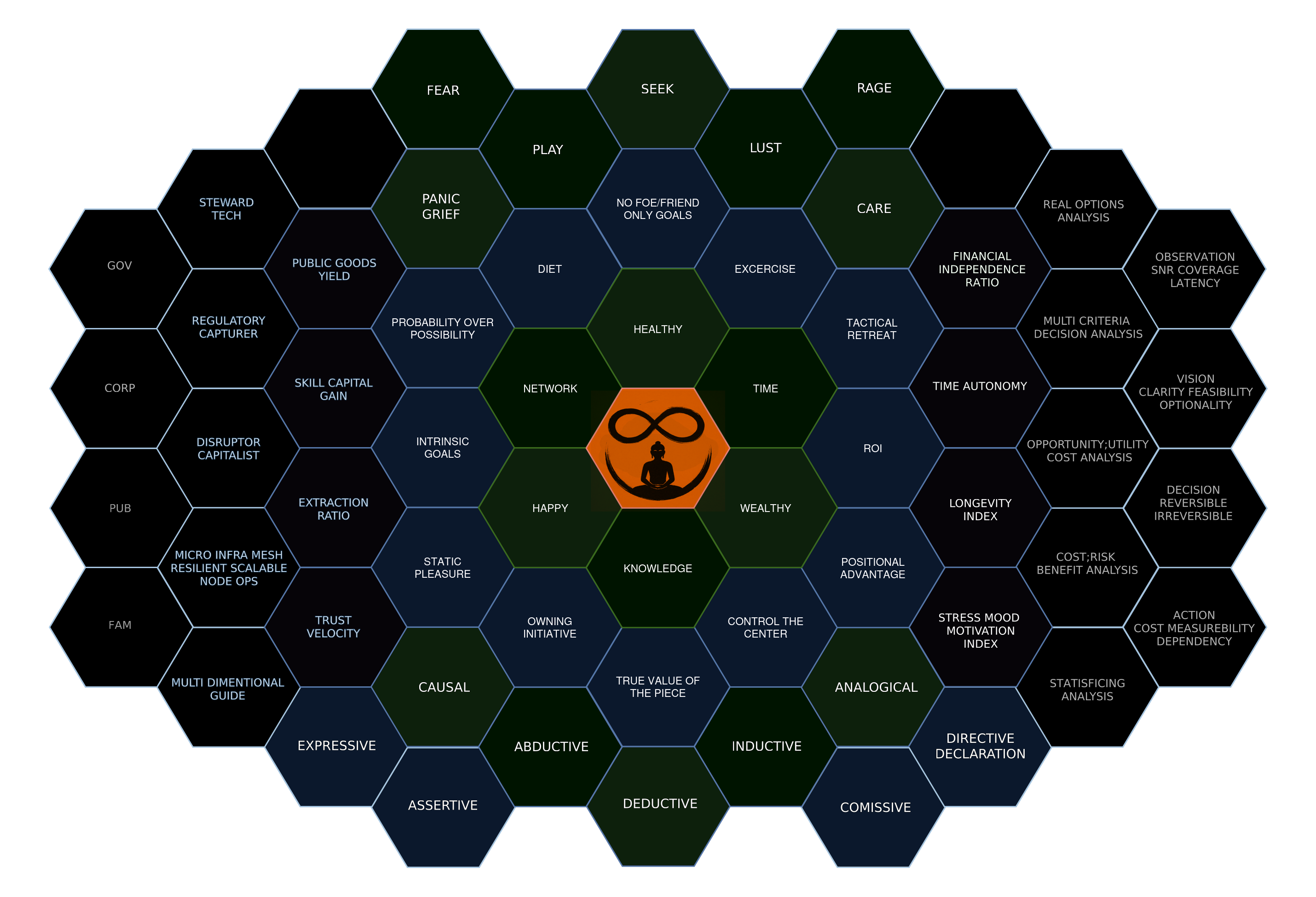
Center Icon — Noumena / Phenomena
The center represents the philosophical boundary between noumena (things as they are in themselves) and phenomena (things as experienced through the senses and processed by the mind). Immanuel Kant (1770) theorized that the human mind is restricted to the logical world and can only interpret occurrences according to their physical appearances. We infer only as much as our senses allow, never experiencing the actual object itself. 1
This icon is a permanent reminder: you observe only a tiny fraction of the universe, and much of it is inexpressible in language.
First Circle — Core Resources
The hexagons immediately surrounding the center represent the most important personal resources:
| Resource | Description |
|---|---|
| Health | Without health, life becomes miserable, short, and full of suffering. Every decision should account for short- and long-term health implications. |
| Time | All humans have 24 hours a day. Outcomes are highly influenced by how you spend that time. Partially interchangeable with knowledge (spend time to learn) and wealth (buy others’ time or sell yours). |
| Knowledge | Gaining knowledge during brain development is critical due to declining cognitive flexibility. The best time to learn was yesterday; the second best is today. Interchangeable with wealth - it is easier to make money with knowledge. |
| Wealth | A universal unit of exchange in capitalist society. Do not confuse wealth with currency. Understanding how the financial system works is crucial for compounding. Wealth can be expressed as territory in terms of Accelerationism philosophy. 2 |
| Network | The right connections can open any door and get you out from nearly any situation. |
| Happiness | A chemical state. Train yourself to feel happiness from actions that lead toward your objectives. |
Second Circle — Strategic Positioning
These hexagons represent decision frameworks and positioning principles:
| Principle | Description |
|---|---|
| ROI | Know exactly why you perform each action. Remember total cost of ownership (acquisition, maintenance, disposal) in terms of money, time, cognitive load, and physical load. |
| Positional Advantage | Do not commit to or place yourself in a disadvantageous position. Any move that reduces your optionality is disadvantageous. |
| Control the Center | Seek higher social value and greater influence over the process or situation. |
| True Value of the Piece | Know your strengths and weaknesses. Position yourself where your strengths matter. If you are a good chess player, do not play checkers, maybe only once for experience. |
| Owning Initiative | Being first confers a time advantage. Others become your followers. |
| Static Pleasure | Epicurus identified three types of desire: natural and necessary (food, water, shelter - easy to satisfy, limited consumption), natural but not necessary (luxury - difficult to obtain, infinite improvement, smaller marginal gains), and vain and empty (power, fame - impossible to satisfy, creates pain). Static pleasure equals the absence of pain. Hedonic adaptation means happiness reverts to the mean over time. 3 |
| Intrinsic Goals | Focusing resources on intrinsic goals yields more happiness and life satisfaction than extrinsic ones. |
| Probability over Possibility | Everything is possible, but reasonable decisions must be based on probability, not possibility, to avoid cognitive bias. |
| Diet | Has a higher impact factor than exercise and strongly influences health. Derived from the Health and Happiness resources. |
| No Foe/Friend - Only Goals | Maintain long-term relationships and respond appropriately to attacks, but recognize that friends can betray and enemies can help. Avoid unnecessary conflict - the ROI is usually negative. With 8 billion people on Earth, finding the right people is often more efficient than forcing broken dynamics. |
| Exercise | Critical for blood circulation, VO₂ max, and strongly correlated with longevity, health, and cognitive function. The brain needs oxygen; mitochondria need high/low oxygen spikes (HIIT-style training) to function properly. |
| Tactical Retreat | Leverage time when necessary. Do not make emotional or rushed decisions. |
Brain Modes
The top-middle section maps common default brain states:
Seek · Play · Panic · Grief · Fear · Lust · Rage · Care
The most common default is Seek mode. Be mindful: the seek loop can be hijacked by slot-machine algorithms - infinite scroll, social media feeds, YouTube recommendations, and similar mechanisms. 4
Reasoning Types
The bottom-middle section covers the primary modes of reasoning:
| Type | Direction | Certainty Level | Primary Question | Key Weakness |
|---|---|---|---|---|
| Deductive | General → Specific | Certain (if valid) | “What must be true?” | A false premise or invalid logic structure |
| Inductive | Specific → General | Probable | “What is likely true?” | Sample too small, biased, or a counter-example exists |
| Abductive | Observation → Explanation | Plausible | “What is the best explanation?” | A simpler or more probable alternative exists |
| Analogical | Specific → Specific | Comparative | “What is this like?” | A critical disanalogy breaks the comparison |
| Causal | Event → Outcome | Mechanistic | “Why did this happen?” | Mere correlation, confounding variable, or reverse causality |
Speech Act Types
Positioned on either side of the reasoning section, these represent the categories of speech acts from J.L. Austin and John Searle’s Speech Act Theory 5: Deontic powers - the term comes from the Greek word deon, meaning “duty” or “that which is binding.”, book “Making the Social World”
| Class | Illocutionary Point | Direction of Fit | Speaker’s State | Requirement | Example |
|---|---|---|---|---|---|
| Assertive | State how things are | Words → World | Belief | Truthfulness | “It is raining.” |
| Directive | Get hearer to act | World → Words | Want/Desire | Hearer compliance | “Close the door.” |
| Commissive | Commit speaker to act | World → Words | Intention | Sincerity | “I promise to go.” |
| Expressive | Express feeling | None (Presupposed) | Emotion | Sincerity | “I’m sorry.” |
| Declaration | Change reality | Double (Both) | N/A | Institutional Authority | “You’re hired.” |
Civilization Entity Types (Left Columns)
The left side of the wallpaper maps entities and your relationship to them:
Column 1 — Entity Types: Governments, Corporations, Public, Family
Column 2 — Advantageous Positions (relative to Column 1):
| Position | Description |
|---|---|
| Steward Tech | Maintaining and guiding critical technical infrastructure |
| Regulatory Capturer | Influencing regulation to your advantage |
| Disruptor Capitalist | Creating market disruption for value extraction |
| Micro Infra Mesh Resilient Node Ops | Operating decentralized, resilient infrastructure nodes |
| Family Guide | Steering family resources and decisions |
Column 3 - Observable Metrics:
| Metric | Description |
|---|---|
| Public Goods Yield | Return received from the government on taxes paid |
| Skill Capital Gain | What did you learn, and how can you leverage it for compound effect? |
| Extraction Ratio | How much is extracted from you - taxes, shadow work (e.g., assembling IKEA furniture), time costs |
| Trust Velocity | How quickly do people start to trust you? Correlates with communication skill |
Personal Metrics (Right Columns)
The right side focuses on individual measurement:
Column 3 - Personal Metrics:
| Metric | Description |
|---|---|
| Financial Independence Ratio | Progress toward financial autonomy |
| Time Autonomy | Control over how you spend your time |
| Longevity Index | Health and lifespan trajectory |
| Stress / Mood / Motivation Index | Psychological state tracking |
Column 2 - Methods of Analysis:
These frameworks help analyze situations from multiple angles for example, something might have low financial return but high utility value, or an offer might be too risky to accept:
| Method | Description |
|---|---|
| Real Option Analysis | Treats decisions as financial options - values the right (but not obligation) to act later as uncertainty resolves |
| Multi-Criteria Decision Analysis | Evaluates alternatives against multiple, often conflicting criteria using weighted scoring |
| Opportunity Cost Analysis | Measures the value of the best alternative forgone when making a choice |
| Utility Cost Analysis | Assesses subjective satisfaction or usefulness relative to cost, beyond pure monetary value |
| Cost-Benefit Analysis | Compares total expected costs against total expected benefits to determine net value |
| Risk-Benefit Analysis | Weighs potential positive outcomes against probability and severity of negative outcomes |
| Satisficing Analysis | Selects the first option that meets minimum acceptable criteria rather than optimizing for the best possible outcome |
Column 1 — Decision-Making Process:
A structured flow for evaluating actions. Each stage has specific factors to assess before moving forward:
| Stage | Factors | How to Apply |
|---|---|---|
| Observation | Signal-to-Noise Ratio / Coverage / Latency | SNR: Is the information you’re acting on reliable, or is it buried in noise (rumors, biases, incomplete data)? Seek higher-quality sources. Coverage: Are you seeing the full picture, or just one angle? Missing perspectives create blind spots. Latency: How stale is your information? |
| Vision | Clarity / Feasibility / Optionality | Clarity: Can you clearly articulate what success looks like? Feasibility: Do you have (or can you obtain) the resources, skills, and time required? Constraints. Optionality: Does this path keep future doors open, or does it lock you into one trajectory? Prefer paths that preserve flexibility. |
| Decision | Reversible / Irreversible | Can you undo this? Reversible decisions (trying a new tool, taking a class) deserve less deliberation, act fast and iterate. Irreversible decisions (quitting a job, large financial commitments) warrant thorough analysis and slower pacing. Jeff Bezos calls these “Type 2” (reversible) vs “Type 1” (irreversible) decisions. |
| Action | Cost / Measurability / Dependency | Cost: How much is it going to cost you time, effort, money? Measurability: How will you know if it worked? Define success metrics before starting so you can evaluate outcomes objectively. Dependency: Does this action require other people, systems, or conditions outside your control? High dependency increases risk and reduces your ability to execute independently. |
How to Use This System
Each section of the wallpaper should trigger recall of the deeper explanations above. Your thought process can be guided by looking at different hexagons depending on the context:
- Making a decision? Check the Decision-Making Process column and the Methods of Analysis.
- Feeling distracted? Check Brain Modes - are you in Seek mode, and has it been hijacked?
- Evaluating an opportunity? Run it through ROI, Positional Advantage, and Probability over Possibility.
- Feeling off balance? Review Core Resources - which one is being neglected?
- Navigating social dynamics? Consider Speech Act Types and the Civilization Entity positions.
The system is meant to be glanceable - a quick visual check-in that orients your thinking without requiring deep study each time.
Conclusion
This mind firmware is a personal toolkit, a visual scaffold for the concepts and frameworks I use most often. Modify it, and make it yours. Then set it as your wallpaper and let it do its job.
After party
I hope this post helps you stay focused on your goals and achieve your objectives. I’d love to hear your feedback and improve this further.
Thank you!
P.S.: Good old human paranoia never fails.